Capacitance range: Typically, capacitors with values between 0.1μF and 10μF are selected to meet the signal transmission requirements of most audio circuits.
Material selection: Prioritize capacitors with lower losses such as mica, polypropylene (PP), polyester (PET), and ceramic. These capacitors feature low equivalent series resistance (ESR) and excellent high-frequency characteristics, which can reduce signal distortion and enhance audio clarity.
Application Scenario: Coupling capacitors are used to block DC components and transmit AC signals, commonly found between stages of amplifiers. For instance, in signal transmission between a preamplifier and a power amplifier, a 0.47μF polypropylene capacitor can effectively preserve audio details.
Audio coupling typically employs non-polarized capacitors. These capacitors serve to isolate DC voltage and allow AC signals to pass in audio circuits. Below are the common types of audio coupling capacitors and their related information:
Polyester capacitor (PET capacitor):
Features: It has good stability and a long service life.
Applicable scenario: Suitable for medium to low-frequency audio signals.
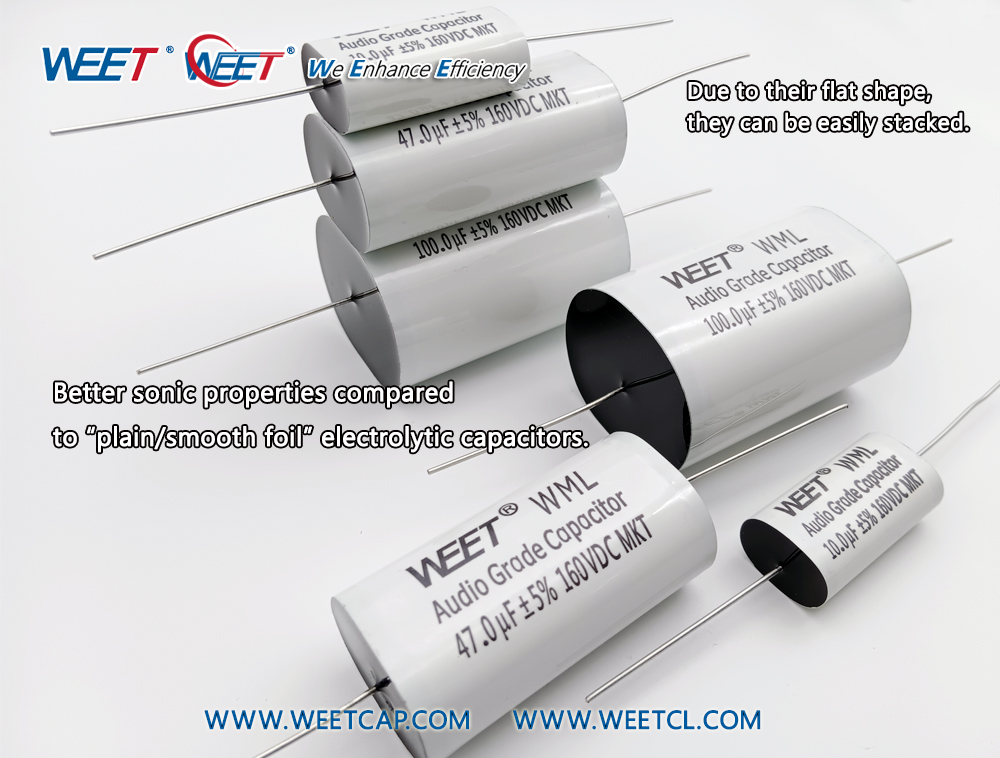
Recommended models: WMA, WMB, WML
Main Product: WML, 160V, 1μF to 100μF. Due to their flat shape, they can be easily stacked when it is necessary to couple multiple capacitors in parallel to achieve a higher capacitance value for a specific crossover position
Polypropylene Capacitor (PP Capacitor):
Features: Wide capacitance range and small tangent of loss angle.
Applicable scenario: Suitable for medium to high-frequency audio signals.
Recommended models: WMC, WMD, WME, WMF, WMT
Key Products: WME, 50V, 100V, 250V, 400V, 630V DC, 0.1µF to 100µF, Ideal for Audio-Related Applications